
Next Planetary Alignment in the UK: Date & Viewing Times
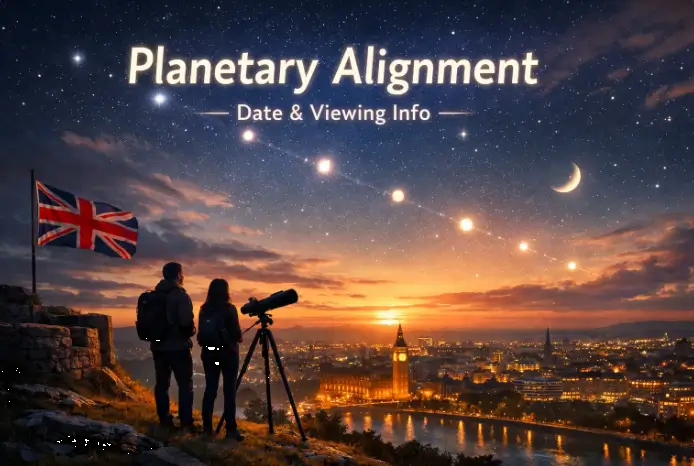
If you are wondering when you can witness the next planetary alignment in the UK, you are in the right place. Astronomical enthusiasts across the country are gearing up for this rare “planet parade.” Finding the exact next planetary alignment in the UK date and viewing time is crucial, as visibility depends heavily on your specific latitude and local weather conditions.
Quick summary
To get the best view of the next planetary alignment in the UK, you should head away from city lights. Unlike single star observations, a planetary alignment involves several planets lining up in a small sector of the sky. Keeping track of the next planetary alignment in the UK allows you to prepare your telescope or binoculars in advance for the most striking celestial display of the year.
Here are the essentials at a glance to help you plan the evening.
Peak night:
March 1, 2026. Best UK viewing is roughly 6:00 to 7:00 PM GMT; check local sunset times and BST
changes.
Planets visible:
Mercury, Venus, Saturn, Jupiter, Uranus and Neptune along the ecliptic. Uranus and Neptune may need
binoculars or a small telescope.
Where to watch:
Choose an unobstructed western horizon such as a coastal cliff, hilltop, or elevated park. Avoid skyline
clutter and bright street lamps.
What to bring:
Binoculars, a tripod for photos, warm layers and a red-light app for star charts. Arrive a few minutes
early to let your eyes adapt.
Cloudy options:
Follow live streams, join local astronomy clubs or use planetarium software to recreate the sky for your
location and time
Best time to see planets alignment UK
If you need a short reply to when will the next planets aligned event be visible in the uk, the highlight
happens on the evening of March 1, 2026. For much of England the main observing window falls roughly
between 6:00 and 7:00 PM GMT, typically 30 to 60 minutes after sunset when twilight has faded. Use an
astronomy app or local sunset calculator to set the exact minute for your town.
Mercury will be very low and may set quickly while Jupiter and Saturn remain visible longer into the
evening. Uranus and Neptune are faint and usually need binoculars or a small telescope to spot. If clouds
block March 1, try Feb 28 or Mar 2 as backup nights and arrive 10 to 15 minutes early to set up gear and
adapt your eyes
Which planets you'll see and where to look in the sky
The March 1 grouping lines up six planets along the ecliptic, the same arc the Sun and Moon follow
across the sky. Mars is not part of this parade, so you can avoid confusing any reddish object with the
group. Below are the planets to expect and how they typically appear to the eye or through optics.
Mercury
: faint and very low near the horizon, often tricky in twilight and may set quickly.
Venus
: very bright and unmistakable, easily seen with the naked eye.
Saturn
: moderately bright and visible without optics; a small scope will hint at the rings.
Jupiter
: bright and obvious, usually the highest and most prominent of the group.
Uranus
: dim, best seen with binoculars as a small greenish dot.
Neptune
: very faint, typically requires a small telescope and a star chart to confirm.
Typically from the horizon the order is Mercury lowest, then Venus, Saturn with Neptune nearby, Uranus
higher, and Jupiter highest and brightest. “Aligned” here means they trace the same arc rather than
forming a perfect line, and optical aid brings out the faint pairings more clearly. In towns Mercury and
Venus may disappear behind buildings, so test your western sightline in daylight to avoid surprises
Best UK viewing spots and city-specific tips
Where you stand will make the difference between a clear view and a frustrating one. Aim for a location
with a clear western horizon, such as coastal promenades, hilltops, or large parks, and keep bright street
lighting behind you to protect night vision. In built-up areas a rooftop or high-floor balcony with an open
western exposure can work if access and safety are sorted.
Unobstructed western horizon:
Low planets hug the horizon, so a clear sightline matters.
Avoid bright lights:
Keep street lamps and spotlights behind you to preserve night vision and help spot faint objects.
Bring optics:
Binoculars or a small telescope will help with Uranus and Neptune, especially in light-polluted areas.
Latitude affects twilight length and the planets’ setting angles, so check your local sunset and test where
the Sun sets behind obstacles during daylight when planning your viewing window.
How to observe: equipment, apps and photography tips
A small kit makes the evening comfortable and productive. Bring warm layers, a small chair, and a red torch so you can read star charts without ruining night vision, and carry a lens cloth for dew if you’ll stay outside. Aim to be in place 10 to 15 minutes before the peak window to let your eyes adapt and check sightlines.
- Binoculars (7×50 or 10×50) and a small tripod or brace.
- Charged phone with your chosen app preset to March 1, 2026 and location locked.
- Red torch, warm layers, small camp chair, and a lens cloth.
- Camera tripod and phone adapter for photography.
Expect Venus and Jupiter to be simple to spot with the naked eye and Saturn to be visible without optics. Use binoculars to confirm Uranus and a small telescope for Neptune, and keep a star chart or app handy to avoid mistaking stars for planets. Recommended apps include Stellarium Mobile for precise simulations, SkySafari for quick planet positions and Star Walk’s coverage of the planetary alignment or SkyView for augmented-reality pointing; save a screenshot or preset the date for offline use. For a UK-focused quick reference, consult the Tonight’s UK Night Sky Guide February 2026 to cross-check horizon positions and timings for major towns.
For photos, use a tripod and put your phone in pro mode to lock focus on a bright planet and use short exposures. Brace binoculars on a table or use a tripod adapter, and for small telescopes try eyepiece projection with short exposures unless you have a tracking mount. Capture many frames for stacking and prefer a wide-angle composition that includes the horizon so the six-planet grouping reads clearly in the final image.
Cloudy skies? Live streams, clubs and digital keepsakes
Clouds or city glow do not have to stop you from experiencing the event. Several observatories and
astronomy groups run live streams for major celestial events; check the Royal Observatory Greenwich, the Virtual Telescope Project live streams and university channels on YouTube for coverage and telescopic
close-ups. For background reading and viewing tips from news outlets, see India Today’s how-to-watch
guide. Live streams are especially useful when telescopes are needed to reveal Uranus and Neptune.
For a faithful digital record use planetarium software such as Stellarium to recreate the exact sky for any
location and time. Set your town and March 1, 2026 in the software to generate high-resolution
screenshots for sharing or printing. To get hands-on help, book a session with a local astronomy club or
community observatory; clubs provide instruments, darker horizons and experienced observers to help
you spot faint objects
Commemorate the March 1 parade with a custom star map
A personalised star map turns the moment into a keepsake you can hang at home or give as a gift. Starmaps.uk uses Hipparcos and Tycho coordinates so stars and planets match the true sky at the time and place you specify. The online editor lets you preview placements, pick a colourway, and add a short caption for extra personalisation.
Making a March 1, 2026 map takes moments: enter your UK location and the date, add the event time if you want extra precision, choose a style and preview before checkout. Pick a digital download for instant delivery or select printed and framed options for an archival, ready-to-hang gift. Formats include digital download, premium poster, framed print and canvas art to suit different budgets and interiors. If you prefer a precise plotted view, use the Starmaps.uk star chart tool to confirm planet placements for your chosen time and horizon.
Caption ideas: “March 1, 2026 — six planets above London, 6:10 PM GMT” or “The night the planets paraded for us.” Pair a minimalist black frame with modern interiors, hang above a mantel or in a nursery, and tuck a handwritten note describing where you watched to personalise the gift further.
When will the next planets aligned event be visible in the UK: final takeaways
Short answer: the evening of March 1, 2026, with the prime UK viewing window generally around 6:00
7:00 PM GMT (about half an hour after sunset for many locations). Choose a spot with a low western
horizon, arrive early so your eyes can adapt, and bring binoculars if you want to see Uranus and a small
telescope for Neptune. Confirm exact times for your town via an app or sunset calculator — for example,
see TimeandDate’s sunset calculator for London — and keep Feb 28 and Mar 2 as backup nights if
weather is poor.
Add March 1 to your calendar, pick a viewing spot and decide whether you’ll photograph the event or
simply watch. If you want to preserve the sky, create a custom star map at Starmaps.uk—specify the
location and exact time to match the sky you saw, then choose from digital downloads or framed prints
with fast UK delivery
Don’t miss out on the next planetary alignment in the UK date and viewing time; it is a moment worth capturing forever. Many of our customers choose to commemorate these rare astronomical events by creating a personalised star map of that exact night. Whether it’s a planet parade or a meaningful anniversary, you can immortalize the sky as it appeared during the next planetary alignment in the UK with our custom tools.
Next planetary alignment
Next planetary alignment. NASA has confirmed that this phenomenon will repeat in 2040, making this event an unmissable opportunity for both amateur astronomers and those who wish to explore the cosmos.