Stargazing in the UK: A Beginner’s Guide to Seasonal Constellations
There is something profoundly moving about looking up at the night sky and realizing that the glittering tapestry above us is constantly changing. For centuries, stargazing has connected us to history, science, and the deeper mysteries of the universe. If you are starting your journey into astronomy from the United Kingdom, understanding which constellations are visible during each season is the perfect first step to navigating the celestial sphere.
While some star patterns remain visible all year round due to the UK’s geographical position, others make brief, spectacular appearances before dipping below the horizon. This comprehensive guide will show you exactly what to look for, when to look for it, and how the UK night sky shifts throughout the year.
The Everpresent Stars: UK’s Circumpolar Constellations
Before diving into the seasonal shifts, it is essential to understand that certain constellations never leave the British sky. These are known as circumpolar constellations. Because of the UK’s northern latitude, these stars circle closely around the Celestial North Pole (marked by Polaris, the North Star) and never set below the horizon.
Ursa Major (The Great Bear & The Plough)
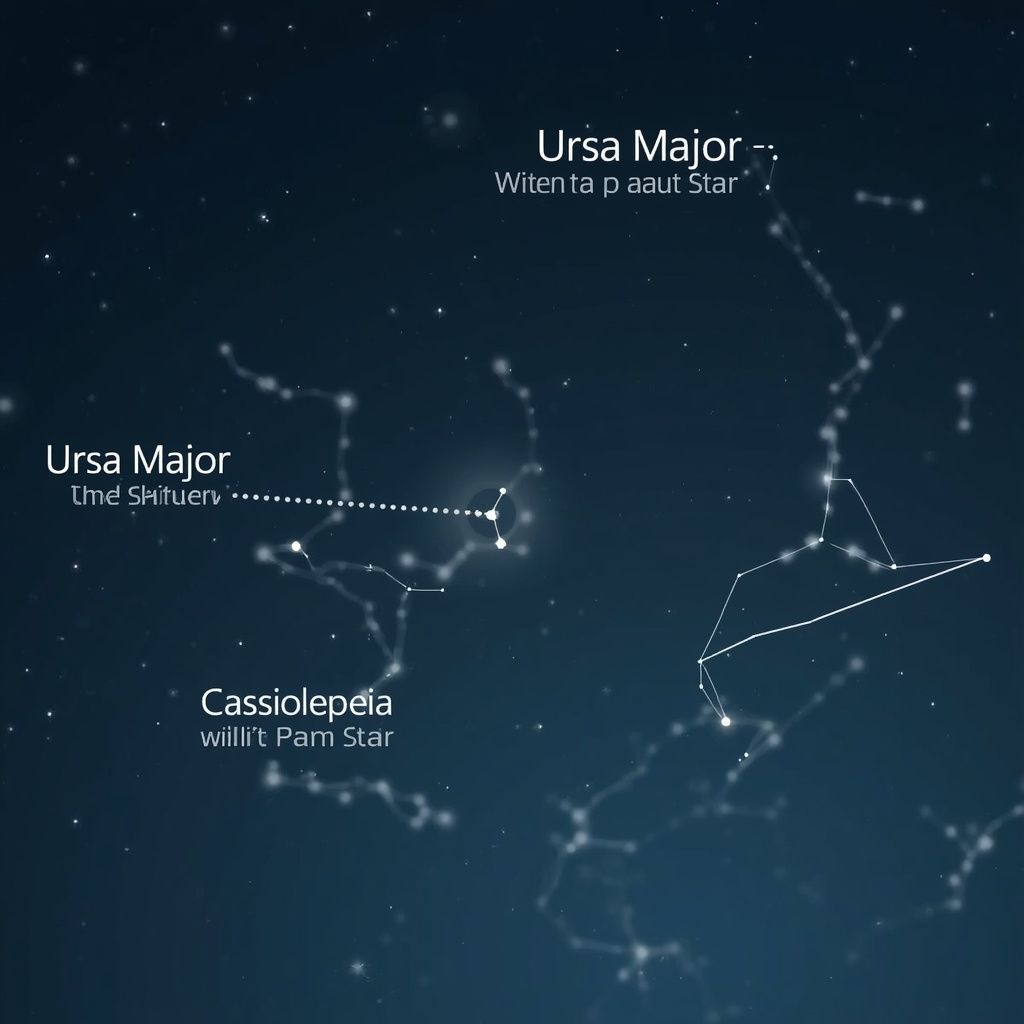
Undoubtedly the most famous star pattern in the Northern Hemisphere, Ursa Major is the ultimate celestial signpost. Most people recognize its seven brightest stars as “The Plough” or “The Big Dipper”. In the UK, you can use the two pointer stars at the edge of the Plough’s “bowl” to draw an imaginary straight line directly to Polaris, making it an invaluable tool for night-sky navigation.
Cassiopeia (The Queen)
Positioned directly opposite the Plough across the North Star, Cassiopeia is instantly recognizable by its distinct “W” or “M” shape formed by five bright stars. It sits high in the sky during autumn evenings and offers an excellent baseline for locating deeper astronomical objects, such as the Andromeda Galaxy.
Spring Constellations: The Lion Awakens
As winter fades and British evenings start to get slightly warmer, the winter giants depart, making room for fresh, elegant geometric star patterns. Spring stargazing in the UK requires a bit of patience as the nights get shorter, but the clarity of the sky often rewards onlookers.
Leo (The Lion)
Leo is the undisputed king of the spring sky, visible from March through May. It is one of the easiest zodiac constellations to identify because its western section forms a backward question mark pattern known as “The Sickle,” which represents the lion’s mane. The base of this sickle is marked by Regulus, a brilliant blue-white star that is roughly four times larger than our Sun.
Bootes (The Herdsman)
Rising in the east during spring, Bootes looks remarkably like a giant kite or an ice cream cone. Its crowning jewel is Arcturus, the brightest star in the northern celestial hemisphere. You can easily find it by following the natural curve of the Plough’s handle in an arc across the sky—a technique astronomers call “arcing to Arcturus.”
Summer Constellations: The Celestial Triangle
Summer nights in the UK are notoriously short, and twilight can linger for hours. However, midsummer offers some of the most striking high-altitude alignments, dominated by a massive atmospheric formation that spans across the entire sky.
The Summer Triangle and Cygnus (The Swan)
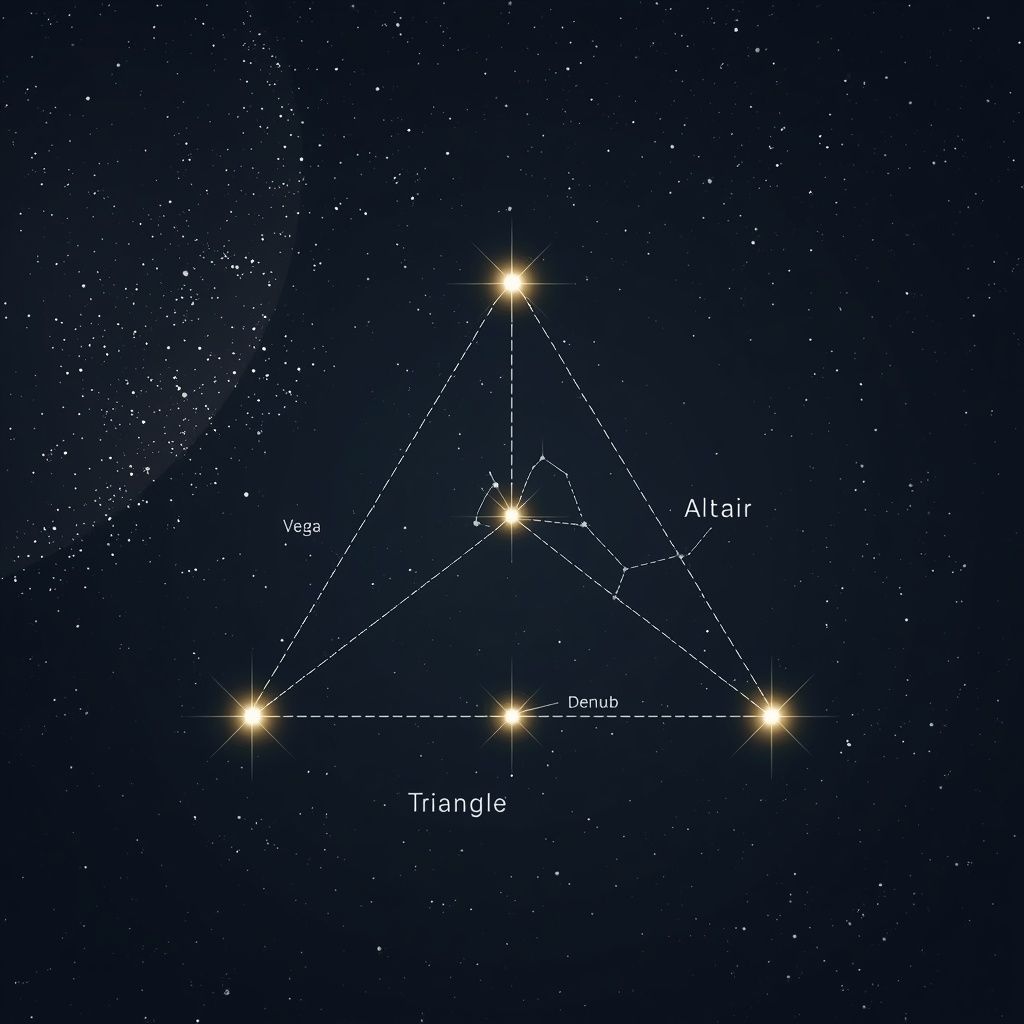
While not a constellation itself, the Summer Triangle is an asterism formed by three bright stars from three different constellations: Vega (in Lyra), Altair (in Aquila), and Deneb (in Cygnus). Cygnus, also known as the Northern Cross, flies right down the middle of the Milky Way. Its graceful cross shape represents a swan in full flight and offers a breath-taking sight on dark, moonless August nights away from city lights.
Autumn Constellations: Myths of the Ancient Sea
As the autumn leaves begin to fall in the UK, the nights lengthen significantly, bringing ideal conditions for backyard astronomy. The autumn sky is dominated by an interconnected web of constellations named after characters from ancient Greek mythology.
Pegasus (The Winged Horse) and Andromeda
The defining feature of the autumn sky is the “Great Square of Pegasus.” This massive, clean square of four stars represents the body of the mythical winged horse. Connected directly to the top-left corner of the square is Andromeda. For stargazers equipped with binoculars, this area holds the ultimate prize: the Andromeda Galaxy (M31), the most distant object visible to the naked human eye at 2.5 million light-years away.
Winter Constellations: The Return of the Giants
Ask any seasoned astronomer in the UK, and they will tell you that winter is the golden season for stargazing. The cold, crisp air holds less moisture, leading to exceptionally transparent skies, and the stars that arrive in December are among the brightest and most dramatic in the universe.
Orion (The Hunter)
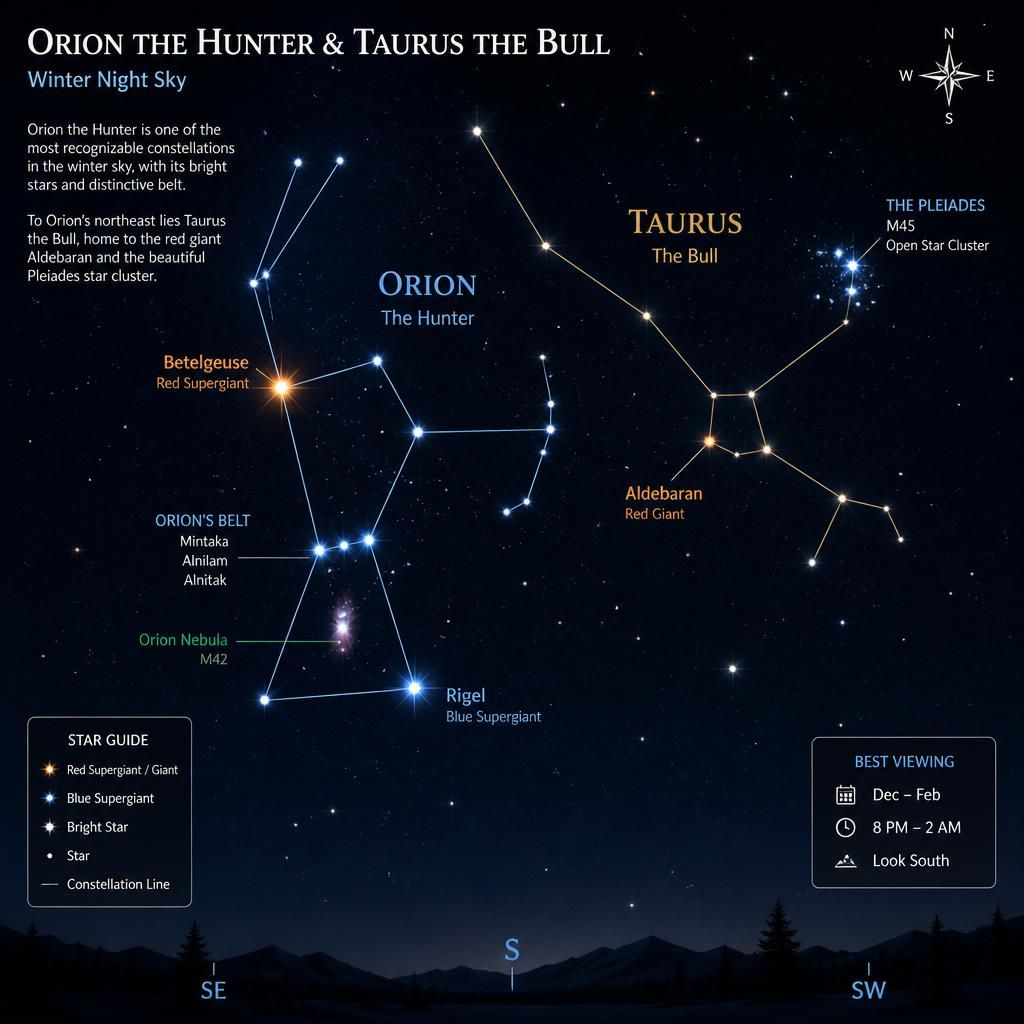
Orion is the undisputed masterpiece of the winter sky, visible from November to February. Its perfectly straight three-star “Belt” is instantly recognizable even through heavy urban light pollution. Look closely at Orion’s shoulders and feet: the bright red supergiant Betelgeuse sits at his left shoulder, contrasting beautifully with the icy-blue supergiant Rigel at his right foot.
Taurus (The Bull) and the Pleiades
Just above and to the right of Orion lies Taurus, marked by the bright orange eye-star, Aldebaran. Riding on the back of the bull is the Pleiades (The Seven Sisters), a stunning open star cluster that looks like a tiny, shimmering miniature dipper. Spotting the Seven Sisters clearly is an age-old test of excellent eyesight.
To learn more about how these patterns move, check out our full guide on
The positions of these constellations do not just define the seasons; they map out the exact moments of our lives. Because the Earth’s orbit around the Sun ensures that the stars align in a unique configuration every single night, the sky above the UK on the night you were born, married, or shared a milestone anniversary is completely unrepeatable.
Documenting these stellar alignments through custom astronomical calculations allows you to freeze that specific overhead view forever. Whether it’s the towering presence of Orion on a crisp winter night or the glowing path of the Summer Triangle during a warm August evening, the stars remain the ultimate, timeless witnesses to our most precious human stories.