What Do the Zodiac Constellations Actually Look Like in the UK Sky?
Most of us are familiar with our star sign, but very few people have actually looked up at the night sky and spotted the real zodiac constellations. In modern culture, the zodiac is deeply tied to astrology. However, long before horoscopes existed, these twelve constellations served a vital astronomical purpose: they map out the Ecliptic, the exact path the Sun, Moon, and planets appear to travel across the sky throughout the year.
If you are stargazing from the United Kingdom, finding your zodiac constellation can be a fascinating challenge. Because of the UK’s northern latitude and seasonal shifts, some signs dominate the winter sky with dazzling brightness, while others barely skim the southern horizon in summer. This guide breaks down the science of the zodiac and reveals exactly what these iconic star patterns look like in the British sky.
The Winter Zodiac: The Easiest Signs to Spot in the UK
Winter offers the crispest, clearest stargazing conditions in the UK. During these cold months, the constellations riding high in the sky are massive, bright, and incredibly easy to identify with the naked eye.
Taurus (The Bull) – November to February
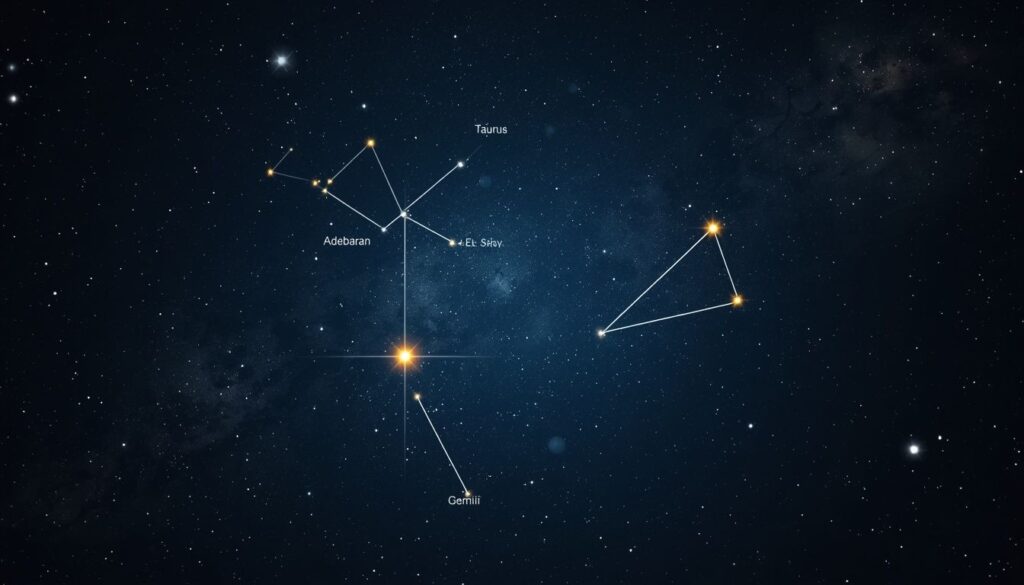
Taurus is one of the most spectacular sights in the British winter sky. To find it, look to the upper right of Orion’s Belt. You will easily spot a distinct, V-shaped cluster of stars known as the Hyades, which forms the Bull’s head. At the heart of this V glows Aldebaran, a massive, fiery orange giant star that represents the angry eye of the Bull. Riding on the Bull’s back is the Pleiades, a breathtaking cluster of blue stars that looks like a tiny shimmer in the dark.
To learn more about how these patterns move, check out our full guide on :
Positioned just above Orion, Gemini resembles two nearly parallel stick figures standing shoulder to shoulder. The constellation is defined by its two brightest stars, Castor and Pollux, which mark the heads of the mythical twins. In the UK, Gemini climbs almost directly overhead during January evenings, making it exceptionally clear even in areas with moderate light pollution.
As the UK transitions into spring, the sky opens up to quieter, more elegant geometric shapes. The spring zodiac signs sit high in the sky, providing excellent landmarks for amateur astronomers.
Leo (The Lion) – March to May
Leo looks remarkably like its namesake, making it one of the few constellations that actually resembles what it is supposed to represent. The front of the Lion forms a backward question mark pattern called “The Sickle,” which traces the majestic mane. At the bottom of this pattern sits Regulus, a brilliant blue-white star that shines as the Lion’s heart.
Virgo (The Maiden) – April to July
Virgo is the largest constellation of the zodiac and the second-largest in the entire sky. Because its stars are somewhat faint, it can be tricky to map out completely from the UK, but it possesses one unmistakable feature: Spica. Spica is a piercingly bright, solitary blue star. You can easily find it by using the curve of the Plough’s handle to draw a line down to Arcturus, and then extending that line straight down to Spica.
The Summer Zodiac: Skimming the British Horizon
Summer stargazing in the UK brings very short nights, but it also reveals constellations that are completely hidden during the rest of the year. Because these signs sit very low in the southern sky, you will need a clear view of the horizon away from tall buildings or trees to spot them.
Scorpio (The Scorpion) – June to July
Due to the UK’s northern position on the globe, British stargazers only get to see the upper half of Scorpio as it skims low along the southern horizon. Despite this, it is well worth hunting for because of Antares, a colossal red supergiant star known as “the Heart of the Scorpion.” Its distinct reddish-pink glow mimics the appearance of Mars.
Sagittarius (The Archer & The Teapot) – July to August
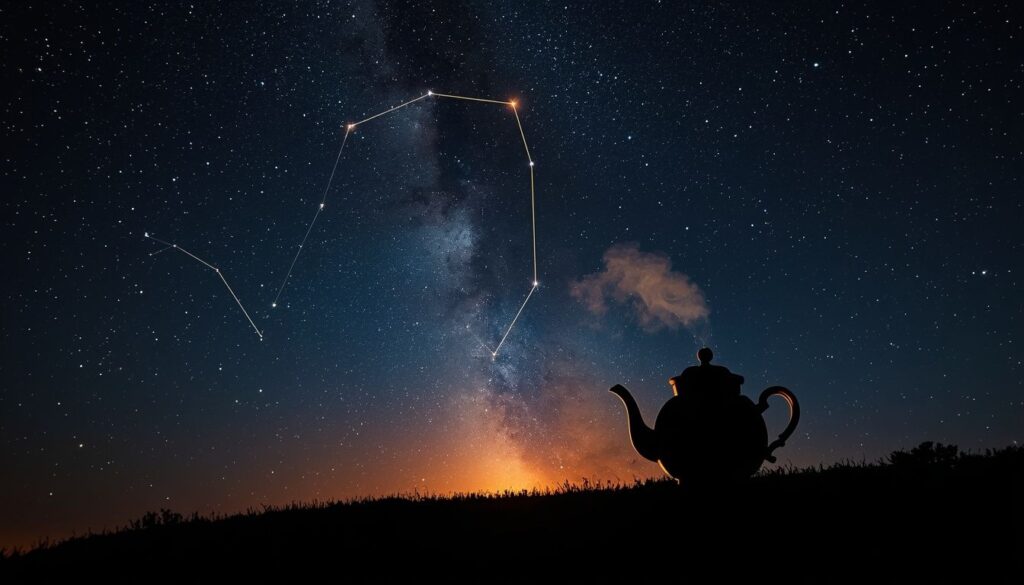
Like Scorpio, Sagittarius sits incredibly low in the southern UK sky. Instead of trying to visualize a mythical archer, modern stargazers look for a much simpler shape within the constellation: an asterism known as “The Teapot.” This clean, geometric pattern looks exactly like a classic teapot, complete with a handle, spout, and lid. On a dark August night, the dense core of the Milky Way galaxy looks like steam rising directly out of the teapot’s spout.
Autumn brings longer, darker nights to the UK, perfect for hunting down some of the more elusive and ancient zodiac patterns that are rich in maritime mythology.
Aries (The Ram) – September to November
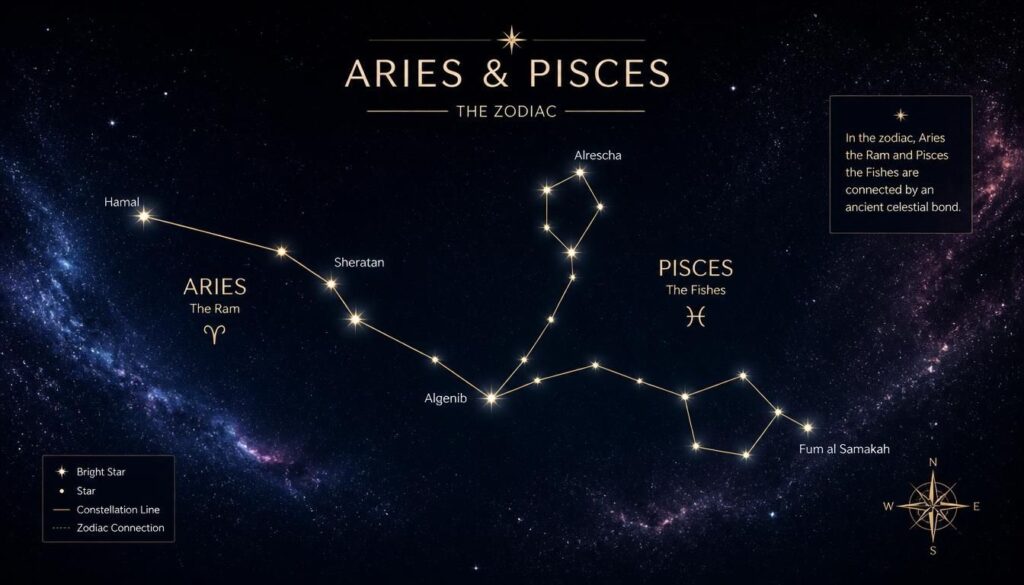
Aries is a compact, understated constellation, but it holds immense historical value as the traditional starting point of the zodiac. It does not look like a ram; instead, it appears as a simple, slightly curved line formed by three stars. The brightest of the trio is Hamal, an orange giant star that sits roughly 66 light-years away from Earth.
Pisces (The Fishes) – September to December
Pisces is a sprawling autumn constellation made of relatively faint stars, meaning you will need a dark, moonless night away from city lights to appreciate it. It forms a large, delicate “V” shape that represents two fish tied together by a long ribbon. One fish swims northward towards Andromeda, while the other swims westward along the celestial equator.
Looking up and finding the exact zodiac constellation that dominated the sky on the day you were born is a powerful reminder of our connection to the universe. Because the Earth is constantly moving, the stars align in a configuration that belongs uniquely to your personal story. The position of Leo during a bright spring night or the sharp silhouette of Taurus in the depths of winter marks a specific chapter in time.
Capturing these real astronomical arrangements allows you to transform a simple date into a beautiful, visual memory. By generating a custom star map based on precise historical data, you can preserve the exact overhead view of the zodiac as it appeared on your most cherished night, creating a timeless piece of personal astronomy to look back on for years to come.